
Introduction
On the 19th of June 2026, President Bola Ahmed Tinubu signed the Nigerian Ports Economic Regulatory Agency Act 2026 (the “Act”) into law. This landmark legislation creates a dedicated agency responsible for the economic regulation of Nigeria’s maritime and port logistics infrastructure. The Act formally repeals the Nigerian Shippers’ Council Act (Cap. N133, LFN 2004), shifting maritime oversight from an advisory shippers’ protection council to an empowered statutory economic regulator that protects the commercial interests of shippers, service providers, and port users. This article examines the key provisions of the Act and its implications for port operations and the maritime industry in general.
THE 2003 – 2006 PORT REFORMS AND THE NEED FOR ECONOMIC REGULATION
Historically, the Nigerian Ports Authority (the “NPA”) combined ownership, operations, and regulatory functions in Nigerian ports. In 2003, the Federal Government began a port-reform programme aimed at improving efficiency, attracting private investment, reducing congestion, and separating government’s landlord role from commercial cargo-handling operations. Hence, between 2005 and 2006, the NPA retained ownership of port land and core infrastructure, while private terminal operators took over terminal operations under long-term concession agreements. This transferred substantial day-to-day commercial power over cargo handling, terminal charges, service delivery, and investment to private operators.
While the 2003–2006 port concession programme transferred terminal operations from the NPA to private operators, it also concentrated significant commercial power in the hands of concessionaires. Port users subsequently raised concerns about unilateral and excessive charges, duplicated tariff items, opaque billing practices, prolonged cargo dwell times, and service delivery levels that failed to justify the soaring cost of port operations. These concerns were particularly acute because terminal operators provided essential services that importers, shippers, and shipping lines could not readily substitute. In response, the Federal Government appointed the Nigerian Shippers’ Council as interim port economic regulator in February 2014 to control tariffs, rates, and charges and to enforce service-delivery standards. The Council’s intervention, however, rested on an interim regulatory framework rather than a purpose-built statute.
These pricing and service concerns have had consequences beyond individual commercial disputes. High and unpredictable port charges, congestion, slow cargo turnaround, and frequent regulatory or policy changes have been identified as factors that raise logistics costs, reduce Nigeria’s competitiveness against regional ports, and weaken investor confidence. For terminal operators, uncertainty over concession renewal and regulatory treatment can discourage new capital expenditure; for shippers, importers, and shipping lines, opaque charges and poor service delivery increase working-capital pressure and make Nigeria a less attractive trade and logistics destination. The 2026 Act was therefore enacted to convert this arrangement into a permanent system of economic regulation, giving the new agency express statutory powers to regulate tariffs, prevent arbitrary and anti-competitive charges, enforce service standards, investigate complaints, and provide enforceable redress for commercial disputes
THE NIGERIAN PORT ECONOMIC REGULATORY AGENCY
The Nigerian Port Economic Regulatory Agency (NPERA) is empowered to administer and enforce the Act, implement the regulatory framework for regulated services, oversee compliance with applicable agreements, and regulate the economic activities of service providers and users within the regulated sector. Its functions also extend to registration requirements, tariff and fee oversight, dispute resolution, competition, and the promotion of international trade, including the implementation of relevant trade and transport instruments.
REGULATED AND RELATED SERVICES WITHIN NIGERIA’S MARITIME SECTOR
Section 52 of the Act directly targets the systemic vulnerabilities highlighted above by establishing an expansive, statutory scope for economic oversight across Nigeria’s trade gateways. Under the Act, the “regulated sector” encompasses all ports, terminals, off-dock facilities, jetties, and offshore platforms utilized for receiving, handling, and providing cargo services for imports and exports. Within this framework, the Act defines “regulated services” broadly to capture the full spectrum of port-related activities, including vessel reception, the carriage, storage, and handling of cargo, freight forwarding and clearance, stevedoring, haulage, cargo consolidation and brokerage, off-dock terminal operations, inland dry port services, seaport terminal and jetty operations, logistics services, and all other services provided within a port. By bringing these core maritime operations and extended supply chain linkages under a unified economic-regulatory umbrella, the new legislative framework creates the statutory mechanism necessary to standardize tariffs, eliminate institutional arbitrage, and de-risk bankable private capital for Nigeria’s port infrastructure.
Some of the key functions of the Agency particularly relevant to regulation, compliance and oversight are as follows:
a. Chargeable Tariffs, Charges and Service Delivery Standards
The Agency, in consultation with regulated service providers and users, is empowered to issue guidelines on tariffs, rates, and charges, including setting floor and ceiling tariff levels for regulated service providers. It is also mandated to monitor and review these rates to ensure compliance with its guidelines, considering local and global economic trends.
Beyond tariff regulation, the Act empowers the Agency to establish service delivery standards that guarantee the availability, adequacy, quality, accessibility, affordability, and predictability of port services. The Agency may also publish applicable tariffs and charges as necessary; any imposition or publication of fees in violation of statutory requirements constitutes a punishable infraction under the Act. Ultimately, these provisions link port tariff regulation directly to service quality, affordability, and operational predictability.
b. Compliance with Existing Operative Port Concessions and Other Agreements
The Agency is statutorily empowered to monitor compliance with approved port concession agreements, service level contracts, and other commercial arrangements governing regulated services. Consequently, existing commercial agreements can no longer be interpreted in isolation from this overarching regulatory framework. Terminal operators, concessionaires, and logistics service providers must proactively audit their existing contracts, focusing on provisions governing tariffs, service benchmarks, regulatory consents, price adjustments, change-in-law clauses, compliance covenants, and termination rights.
This audit is critical for contracts containing unilateral or discretionary price-adjustment clauses. Going forward, parties drafting or negotiating long-term maritime and logistics contracts should explicitly subordinate all pricing, variation, and indexation mechanisms to NPERA’s statutory guidelines, tariff approvals, and regulatory oversight.
c. Oversight of Registration Regime for Regulated Service Providers
The Act introduces a mandatory registration regime for regulated service providers, empowering NPERA to prescribe registration criteria, information disclosure rules, performance standards, and market conduct guidelines. Crucially, existing regulatory approvals issued by other maritime and government authorities are not automatically superseded by the Act. Consequently, operators must maintain dual compliance, aligning with NPERA’s economic framework alongside their existing sector-specific licensing obligations.
This multi-layered architecture creates potential compliance overlaps and operational cost implications across the logistics value chain. To mitigate exposure, market participants must conduct immediate regulatory-perimeter audits to determine whether their activities fall within the statutory scope of regulated services. This involves mapping out all applicable registrations, licenses, permits, and reporting obligations across every facet of their operations. Such audit readiness is imperative for integrated logistics providers whose business models cross multiple supply chain segments. Holding legacy operational licenses from traditional maritime agencies does not insulate a company from NPERA’s statutory registration, reporting, and economic oversight frameworks.
d. Filing of Tariffs, Rates and Charges
From the commencement of the Act, every regulated service provider is required to file its tariff schedules or proposed fee ranges with the Agency. No operator may impose a tariff, rate, levy, or charge for regulated services unless it strictly conforms to guidelines issued by the regulator. Furthermore, service providers must charge fees solely in accordance with approved guidelines, observe prescribed tariff caps, and publicly display all applicable charges.
e. Publication of Charges and Rates
The Act vests exclusive authority in the Agency to issue guidelines governing how tariffs, rates, and charges for regulated services are calculated and published. To ensure market transparency, the Agency is also statutorily required to periodically publish the approved tariff rates payable by port users. To enforce compliance, the Act establishes strict penalties for unauthorized publication. Any entity or service provider that publishes tariffs, fees, or charges in contravention of statutory directives commits an offence, exposing offenders to monetary fines or imprisonment, with escalated sanctions for repeat violations. Penalties are tiered according to the specific category of regulated service provider. Legal publication requirements are satisfied only when tariff schedules are formally submitted to the Agency, conspicuously displayed at the licensee’s business locations, and published in at least one national newspaper or via alternative channels prescribed by the regulator. By mandating multi-channel disclosure and criminalizing unauthorized rates, these provisions institutionalize pricing transparency, guaranteeing that applicable charges remain accessible, verifiable, and predictable for both regulators and port users.
f. Non-Compliance and Enforcement Powers
The Act arms the Agency with robust enforcement powers to penalize any service provider that breaches statutory regulations, guidelines, or administrative directives. Beyond administrative fines and financial penalties, the Agency’s enforcement toolkit includes suspension, revocation, cancellation, or withdrawal of operational registrations, certificates, and permits. This statutory sanction regime gives the regulator substantial leverage to ensure sector-wide compliance. By incorporating the threat of license suspension or permit withdrawal, the Act moves enforcement beyond mere financial penalties, providing a decisive mechanism to halt non-compliant operators from functioning within Nigeria’s trade gateways.
CONCLUSION
The introduction of a statutory tariff-setting framework is one of the most commercially significant features of the Act. NPERA is now empowered to establish guidelines prescribing minimum and maximum levels of tariffs, rates and charges, monitor compliance with those guidelines and review tariffs having regard to prevailing local and global economic conditions. Regulated service providers must file their tariffs with the Agency and publish their applicable fees and rates.
For terminal operators, shipping companies, logistics providers and other service providers, this may affect the extent to which they can independently determine or revise prices for regulated services. While greater transparency may improve predictability for port users and investors, regulated providers will need to factor regulatory approval and tariff ceilings into their revenue models and financial projections. This will also be relevant to lenders and investors financing port infrastructure. Where the revenue assumptions of a project depend on periodic increases in tariffs or service charges, the availability and terms of the relevant NPERA approval may become an important component of the project’s regulatory and financial due diligence. Ultimately, by substituting arbitrary pricing with statutory predictability, the Act transforms regulatory risk into a structured framework, marking a pivotal shift necessary to de-risk investments, unlock institutional capital, and modernize Nigeria’s maritime trade gateways.
About DealHQ
We are an Africa-focused deal advisory/boutique commercial law firm, specializing in supporting businesses and positioning them to operate efficiently within their market sphere. We are known for our quality service delivery, focused on attention to detail, creativity, timely execution, and client satisfaction.
Our service offering includes Energy & Infrastructure, Aviation, Corporate Commercial, Real Estate, Finance, Capital Markets & Derivatives, M&A, Private Equity, Technovation and Data Privacy, Agriculture & Commodities, Business Formations & Start-up Support, amongst others.
This article is for general information only and is not intended to replace professional legal advice. Businesses affected by the Nigerian Ports Economic Regulatory Agency Act 2026 should obtain advice based on the specific circumstances applicable to them. Should you wish to seek specialist legal advice on this or any other related subject, you may contact our Maritime & Infrastructure team –
Email: EnergyPT@dealhqpartners.com, clientservice@dealhqpartners.com
Tel: +234 1 4536427 or +234 9087107575
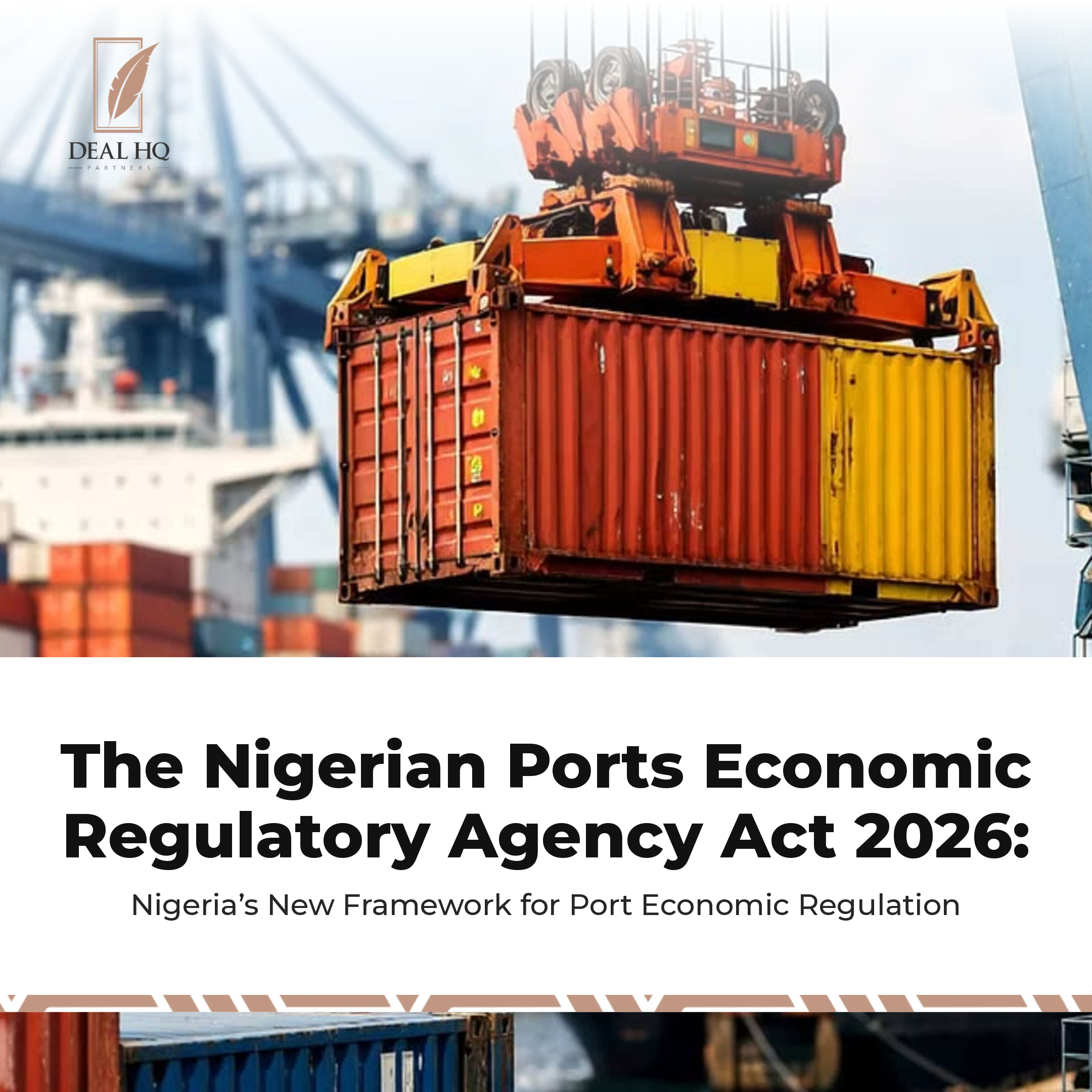
- THE NIGERIAN PORTS ECONOMIC REGULATORY AGENCY ACT 2026: NIGERIA’S NEW FRAMEWORK FOR PORT ECONOMIC REGULATION
- NERC Mini-Grid Regulations 2026: New Introductions and Key Reforms

- REGULATORY UPDATE: REVISED MINIMUM CAPITAL REQUIREMENTS FOR CAPITAL MARKET ENTITIES
- DealHQ Partners_Chambers_Energy & Infrastructure M&A 2025

- NIGERIA’S 2025 PETROLEUM LICENSING ROUND: PREPARATORY GUIDELINES FOR PROSPECTIVE BIDDERS.

- NIGERIA’S NEW INSURANCE FRAMEWORK: THE NEW REALITY AND INVESTOR OPPORTUNITIES

 English
 Portuguese